-
Customer Service QQ
3297421414
-
Phone
Monday to Saturday 9:30 - 22:00
Phone : 18682486380
18126541905 -
Official WeChat
 Scan the official WeChat QR code for an instant quote
Jiechi Electronics Co., Ltd.
100% quality | A global multi-service platform for electronic components
Customer Service QQ
3297421414
Phone
Monday to Saturday 9:30 - 22:00
Phone : 18682486380
18126541905
Official WeChat
Scan the official WeChat QR code for an instant quote2021-08-10 Views:4
IF IN VISIONAI, you will deeply understand that this is a difficult "battle". The main challenges come from the following aspects:
• Completing AI inference in edge devices requires sufficient computing power, while also meeting many constraints such as cost, volume, power consumption, and security. The design of products and solutions is not easy.
• Although the total size of the visual AI market is not small, the phenomenon of "fragmentation" is serious. According to incomplete statistics, there are currently more than 70 related visual use cases on the market, but it cannot be dealt with with a unified solution.
• The rapidly evolving AI technology is also a worry. The ever-changing algorithms, sensor technologies and visual processing processes force developers to follow suit and constantly optimize their designs.
Therefore, if you want to win in such competition, you must not only have the courage to dare to fight, but also need to have higheris "smart" and can find more efficient technical paths, establish its own technical advantages, and widen the gap with others.
adaptive computing platform
Vision in Edge DevicesAI applications generally include AI inference and non-AI pre-processing and post-processing functions, and all of these functions require corresponding high-performance computing power to support. If a chip can be specially designed for a specific visual AI application, it will certainly be the best acceleration solution from a performance perspective. However, the limitations of such a fixed chip solution are also very obvious: First, the research and development costs and time required for dedicated chips will be very high; and this is obviously an irreconcilable contradiction with the fragmented market for visual AI applications and the rapid iteration of technology. The process of
uses integrated programmable logic in terms of hardware (PL) and Arm Embedded Processing System (PS) FPGA SoC are good choices, such as Xilinx’s Zynq UltraScale+ MPSoC. In this way, it is convenient for developers to use one device to meet the computing tasks of the entire visual AI processing process; using the PL subsystem, developers can implement optimal deep learning processing units, video processing and scalable sensor fusion based on specific use cases and based on the latest AI algorithms and processing procedures, finding an optimal balance between high performance and flexibility. PL2303HXA parts produced by
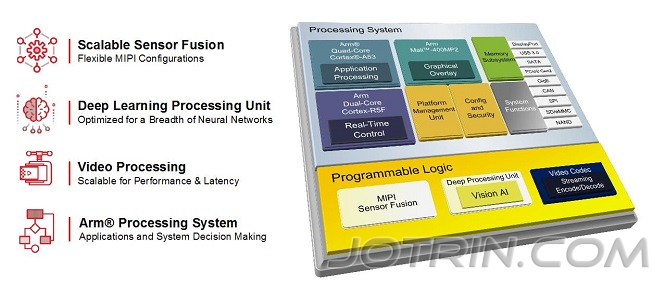
Zynq UltraScale+ MPSoC System Block Diagram The M5673 part produced by
In addition to hardware, a supporting software set is also essential. Xilinx provides developers with a complete tool chain. No matter what level of developer you are, there are software tools available that match the corresponding design path.
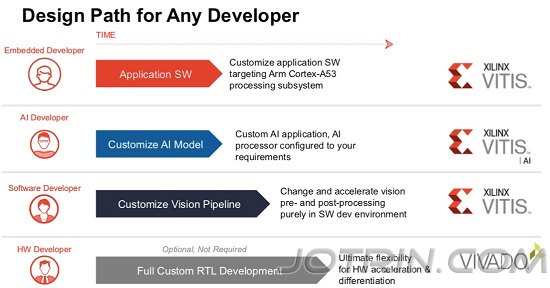
Xilinx's software development tool
The combination of these software and hardware results in a unique"Adaptive Computing Platform", for systems that have both flexibility and efficiency, it is undoubtedly a wise choice to develop an adaptive computing platform based on FPGA SoC.
4K smart camera development platform
After selecting a basic development architecture such as an adaptive computing platform, not everything will be fine. Next, developers will face specific solutions and product development challenges.
Generally speaking, visualAI application development is as follows: first select the chip, build a prototype, and initially verify whether the chip is compatible with the required AI model; then proceed to PCB design and system integration, and perform software and hardware tuning and acceleration on this system platform that is closer to actual commercial use; after final testing and finalization, it is put into mass production.
However, in actual development, visualAI applications are diverse and multi-level. If each application development must start from chip-level design and then go through a complex system integration process, this will require a long R&D cycle and the participation of a complete hardware, software, and PCB development team, which will virtually raise the threshold for R&D. In the development of
enable visualAI applications, should we skip the early chip-level development and PCB design and start from a higher-level, relatively complete productized platform? Or even directly use this development platform as a mature product to simplify the entire development process? The 4K smart camera development platform can meet your requirements. In the "battlefield" of
smart camera development platform include:
• Equipped with a 13-megapixel image sensor and a high-performance image signal processing chip
• The powerful computing power of Xilinx MPSOC can support the deployment of large-scale neural network algorithms
• The Vitis AI development tool suite provides a mature and rich AI model library
• The VCU hard core embedded in MPSOC supports ultra-low latency AVC/HEVC codec
• The low-latency face detection reference engineering source code based on this platform is fully open to users
• The productized hardware structure can quickly transform the user's design into the final product
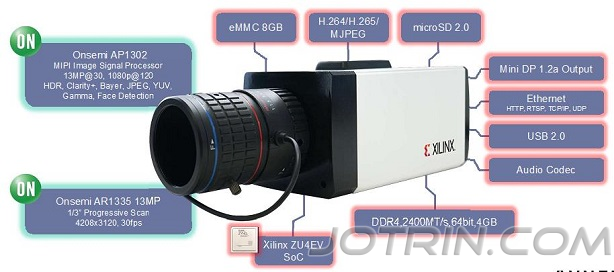
Smart camera development platform Features of the
We can see that this smart camera development platform is based on Xilinx's complete software and hardware adaptive computing platform. It has the support of complete design ecological resources, which is conducive to accelerating the development of final applications.... Application development that was previously prohibitive has become within reach.
During use, developers can either directly apply it in system solutions as a mature smart camera, or take advantage of its powerful performance and flexible scalability as a“AI-box” development platform can be used to explore more possibilities of visual AI applications.
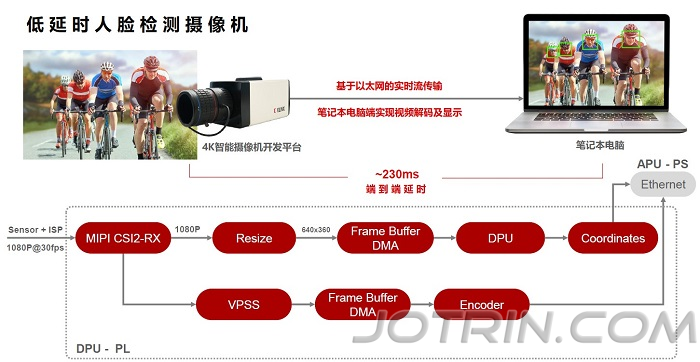
Face detection camera solution based on smart camera development platform