-
Customer Service QQ
3297421414
-
Phone
Monday to Saturday 9:30 - 22:00
Phone : 18682486380
18126541905 -
Official WeChat
 Scan the official WeChat QR code for an instant quote
Jiechi Electronics Co., Ltd.
100% quality | A global multi-service platform for electronic components
Customer Service QQ
3297421414
Phone
Monday to Saturday 9:30 - 22:00
Phone : 18682486380
18126541905
Official WeChat
Scan the official WeChat QR code for an instant quote2021-08-18 Views:2
Heart rate monitoring solution
Heart rate monitoring can be based on ECG signal detection. The periodic beating of the human heart is precisely controlled by bioelectric signals. As long as the ECG signal can be captured, the heart rate can be calculated. However, ECG detection requires the acquisition of multiple potentials in the human body. The hardware implementation is complex and the solution cost is high. One solution is the resonant detection solution,Sensorsenses the pressure changes of arterial pulsation to calculate heart rate. However, the implementation of this solution requires the device to be placed in a part of the human body where the pulse is obvious, which will be a challenge for the way the wearable device is worn. Another solution is photoelectric detection. The basic principle is that blood will reflect red light and absorb green light. When the heart beats, the blood flowing through the skin will increase, and the green light absorbed will also increase; during the heartbeat interval, the blood flow in the blood vessels decreases, and the green light absorbed decreases. When the equipment uses greenLED, combined with a light-sensitive photoelectric sensor, it can detect the blood flow flowing through the human skin at any point in time. Through statistical data, the highest point of each blood flow is regarded as a cycle, so that the heart rate can be calculated. And the device can be designed into a watch shape and can be conveniently worn on the wrist.
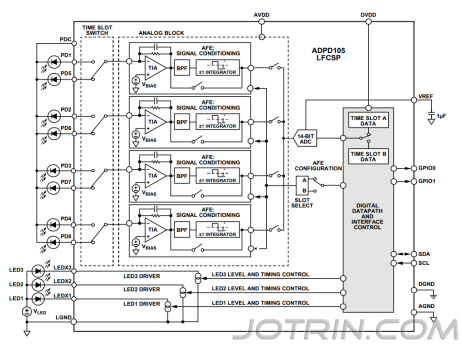
is based on a photoelectric heart rate monitoring solution (also called photoplethysmography PPG). The hardware requires modules such as light source driver, photoelectric conversion, and analog-to-digital conversion data processing. For general light source driving, we choose a constant current source (which needs to be fine-tuned).Currentand a certain frequency.switch); choose photoelectricdiodethen uses an operational amplifier for flow-voltage conversion and signal conditioning; finally, an A/D chip is used to realize digital conversion of the analog quantity and send it toMCUis processed. If the hardware solution uses discrete devices, the number of chips will be larger and the space will be limited, so it is best to use integrated devices.ADIThe company has a multifunctional photoelectricMeasurementfront-end chip (Model:ADPD105), fully integratedAFE、ADC, LED driver and timing core, providing first-class ambient light suppression performance without the need for photodiode filters; flexible digitalinterfaceSPI、I2C is available; low power consumption, 1.8 V analog/digital ultra-low operating power supply, standby mode current of only 0.3μA, suitable forbatteryPowered device; flexible sampling frequency range: 0.122 Hz ~3820 Hz; up to 3 LED constant current sources, with a peak current of 370mA per channel; with WLCSP chip-scale packaging, the ultimate small size is suitable for space-constrained applications. Its internal functional block diagram is shown in Figure 1.
Blood oxygen saturation monitoring solution
Photoplethysmography (PPG) can not only be used for heart rate detection, but also can measure blood oxygen through certain algorithm processing, providing a good solution for non-invasive blood oxygen monitoring.
Principle: Since the two substances oxyhemoglobin (HbO2) and hemoglobin (Hb) have certain absorption characteristics for light with a wavelength of 600 ~ 1000nm. Hb has a higher absorption coefficient for light between 600 and 800nm, and HbO2 has a higher absorption coefficient for light between 800 and 1000nm. Therefore, red light (600 ~ 800nm) and proximity can be used.Infrared(IR) (800 ~ 1000nm) light respectively detects the PPG signals of HbO2 and Hb, and then calculates the corresponding ratio through program processing, thus obtaining the blood oxygen value.
Two channels of ADPD105 LED constant current sources are used to drive red LEDs and near-infrared LEDs respectively, and the other channel constant current source drives green LEDs for heart rate detection. The same one can be used for the light receiver, time-division multiplexed, to collect heart rate signals and blood oxygen signals respectively, and it can be completed efficiently with the minimum number of components.Data collection, comprehensivesynthesishas the lowest cost. In addition, the recent ADI new product ADPD410X is a relatively new product in the ADPD series. It has 8 LED drive optical paths and 8 data acquisition channels, higher integration and sampling accuracy, and supports PPG, ECG andEDAmeasurement. It can be used as a functional expansion plan for this case.
Pedometer Function Solution
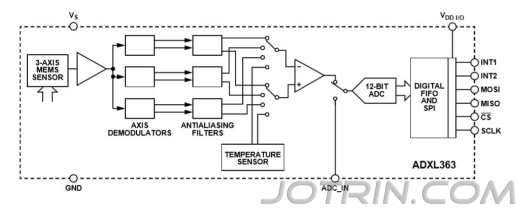
The most commonly used pedometer solution is the three-axis acceleration sensor. Through the algorithm to identify the three-axis dynamic data during walking, the pedometer function can be realized. This solution is based on wearable devices, so the power consumption and size of the chip become important considerations. ADXL363 is an ultra-low-power 3-sensor combination product consisting of a 3-axis MEMS accelerometer,temperature sensoris composed of an ADC input terminal for synchronous conversion of external signals. The power consumption of the entire system is less than 2µA when the output data rate is 100 Hz, and the power consumption is 270 nA in motion-triggered wake-up mode; the 1.6~3.5V operating power supply range is conveniently compatible with the power supply of other devices; ADXL363 also provides access to the internal ADC, which can synchronously convert external analog inputs. The compact LGA package is ideal for wearable device applications. Its internal functional block diagram is shown in Figure 2.
MCU selection
The MCU selection for this solution needs to take into account both high performance and low power consumption. Analog Devices' ADuCM3029 has ultra-low power consumption features: active mode (fully on mode): <30μA/MHz (typ.), sleep mode (with SRAMreserved): "750nA (typ), shutdown mode (optional RTC activity): "60nA (typ); integrated MPUARM® Cortex ® -M3 processor, high-performance core processing algorithm is easy to handle; 256 KB embedded flash memory with integrated ECC is convenient for storing offline data; lower voltage power supply (1.74V to 3.6V) allows the use of button batteries; on-chip peripheral SPI,UART、IIC、TImer、DAC、DMAand Watchdog are all available for easy use; built-in 32kHzOscillatorand 26MHz high-frequency oscillator, also supports externalclockSource; There are two compact WLCSP/LFCSP to choose from, suitable for applications with limited volume and space.
In addition, the high-performance ADuCM4050 can be used as a high-end upgrade version option, which has better performance and lower power consumption in sleep and shutdown modes, in: active mode (fully on mode): " 41μA/MHz (typ.), sleep mode (with SRAM retention): 650nA (typ.), shutdown mode (RTC activity optional): 50nA (typ.); ARM Cortex-M4F processor, 52 MHz, with FPU, MPU, ITM, SWD interface, stronger compatibility, EEC upgrade to 512KB, convenient for storing more offline data;
Power solution
Wearable equipment requires rechargeable power, generally using lithium batteries, so a lithium battery management chip is required. The LTC4065L is a complete constant current/constant voltage linear charger for single-cell lithium batteries, asDimensionsis small (DFN package 2mm*2mm) and able to accurately regulate low charging currents, making it ideal for low-capacity lithium batteries; and can be used withUSBhas standard power-taking work; it also has powerful charging abnormality protection functions: automatic recharging, low battery charge adjustment (trickle charging), and soft-activated function (for limiting inrush current).
In the solution, the MCU, acceleration sensor, and analog front-end chip can all work in the 1.8V range. For 3.7V lithium batteries,LDOis used for step-down. Since C and are constants, the speed n is inversely proportional toAnalog Circuitfor photoelectric conversion, so you need to choose an LDO with as low noise as possible. LT 3042 has ultra-low noise 0.8µVRMS (10 Hz~100 kHz), ultra-high power supply rejection ratio (minimum 79 dB @1MHz); ultra-low operating voltage drop (350mV); adjustable output (0~15V); compact DFN package (3mm*3mm).