-
Customer Service QQ
3297421414
-
Phone
Monday to Saturday 9:30 - 22:00
Phone : 18682486380
18126541905 -
Official WeChat
 Scan the official WeChat QR code for an instant quote
Jiechi Electronics Co., Ltd.
100% quality | A global multi-service platform for electronic components
Customer Service QQ
3297421414
Phone
Monday to Saturday 9:30 - 22:00
Phone : 18682486380
18126541905
Official WeChat
Scan the official WeChat QR code for an instant quote2023-02-09 Views:3
Currently, the traditional “doctor-patient” model is undergoing major changes under the influence of medical wearable devices. Sensors and devices automate many processes, speed up diagnosis and treatment, and allow people to monitor their health. Wearable devices connected to the Internet of Things are disrupting medical practice at a healthy pace, ushering in a new era of digital health.
Wearable Health Technology
Wearable technology refers to electronic devices that people wear on their bodies and can collect different types of data for various purposes.
wearables are definitely the best option for being user-friendly and unobtrusive as they are worn as accessories or sometimes as implants. The industrial applications of wearable technology are already very broad. Many companies use wearable devices to:
Provide safer working conditions and predict employee injuries and fatalities due to fatigue or other factors
improves customer service
Improve productivity
However, the most widespread application of such gadgets can be observed in healthcare and medicine. Wearable health monitoring devices have facilitated the creation of a special branch of healthcare - telemedicine.
Telemedicine is an interdisciplinary field involving the development and application of modern computing and telecommunications technologies in the healthcare industry to monitor people's health conditions and provide remote medical care and treatment. The main benefit of telemedicine systems is the ability to collect information about a patient's health condition anytime and anywhere outside of the clinical setting, thereby saving time and even lives.
More and more people are using smartwatches and fitness trackers to check their activity and health, while patients are provided with monitoring devices to manage disease and take proactive steps to mitigate possible consequences.
Statista’s graph shows significant growth in the number of patients using wearable devices globally from 2013 to 2018. AIC manufactured with
Number of global telemedicine patients from 2013 to 2018 (millions)
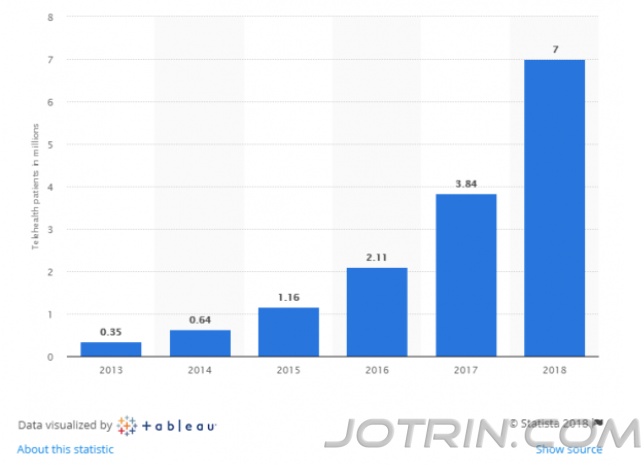
is attributed to technological advancements in medical devices and ubiquitous expansion of smartphones, followed by the creation of mobile healthcare applications. Another reason is that people are increasingly concerned about their health and are willing to adopt wearable devices in their daily lives.
Wearable healthcare technology has a big impact on both doctors and patients as they can stay constantly connected.
patients can control their health 24 hours a day without leaving home or being distracted from work, and get real-time feedback from their doctors. This allows patients to avoid unnecessary hospitalizations or frequent doctor’s office visits, reducing stress and expense.
Wearable devices in healthcare allow doctors to give their full attention to each patient without spending too much time. Wireless data transmission and an alert mechanism send notifications to the hospital so proactive action can be taken immediately if worrisome symptoms occur.
Wearable medical equipment
Wearable technology in healthcare includes different types of devices that can be divided into three categories.
In terms of application areas, devices are divided into three subcategories: for sports and fitness, for remote patient monitoring and for home healthcare.
As for device types, there are smartwatches, activity trackers, patches, and smart clothing.
has two subcategories according to the purpose of use: monitoring and diagnostic equipment to measure your heart rate, pulse, blood pressure, blood sugar levels, sleep, fetal heart rate and nervous system; therapeutic equipment to control pain, aid recovery, pump insulin or provide respiratory therapy.
Healthcare wearable device software development is a rapidly growing market segment. Currently, the leading medical and software manufacturers and suppliers are Fitbit, Medtronic, Nokia, and Philips.
Factors driving adoption of medical wearables
More and more smartphones
Integrating sensors into consumer devices
is an easier way to obtain medical support
more freedom
Increase health and fitness awareness
The intervention of Apple, Google, Microsoft and other giants
Factors hindering the implementation of wearable devices
, the cost is high
Privacy Data Security Issues
Lack of Common Standards
Interoperability issues
Five Trends in Healthcare Wearable Devices
Digital medical care is an effective way to bridge the communication gap between doctors and patients and improve health service levels. The field won't stand still, and certain trends in medical wearables can be pulled apart.
1. Wider equipment range
Smart watches and trackers that are usually worn on the wrist, as well as Google Glass, which is worn with ordinary glasses, are receiving the greatest attention from wearable developers. Some smart implants, such as hearts, are also growing in popularity. Despite the technology's potential, devices for other body parts have lagged behind.
Currently, the trend is to invent more devices for different parts of the body, so the range of medical wearables is expanding. In the future, people will be able to control their health and monitor their health from head to toe using smart helmets, hearing aids, glasses, smart clothing and footwear, skin patches, implantable sensors, and more.
2. Devices become smaller
's first wearable devices were large and bulky, which put most consumers off from using them. The strongest trend now is to minimize the size of devices and make them stylish or unnoticeable. Many wearable devices are designed in such a way that they can be worn as accessories on different parts of the body. Others become so small that they are virtually invisible under your clothes or even on your body.
The main goal of this trend is to make devices more compact and lightweight, thus making them flexible and affordable for everyone. The smaller the device, the more people can participate.
3. Wearable apps become smarter with VR, AR, AI
Wearable applications for healthcare keep pace with modern technology. An increasing number of applications are being created using virtual reality, augmented reality, artificial intelligence and machine learning technologies.
Such applications become smarter and can perform a lot of manual work. For example, doctors receive reports as ready-made results created by machine learning algorithms, so they don’t need to spend time researching and reading papers. This allows them to focus on treating patients. Surgeons can use VR glasses to view X-rays while operating without leaving the room or being distracted during the procedure.
4. Personalization of doctor-patient models
Modern patients do not have time to be sick or waste on unnecessary services, but rather require individual treatment. Wearable devices make this possible. The vast amount of data collected by body sensors helps personalize the healthcare experience. In the future, each client will no longer be treated according to clinical criteria based on averages, but based on individual data and conditions.
Therefore, the way practitioners communicate with patients is changing from universal to personalized. Patient information will become more accessible, which will allow practitioners to find the right treatment options faster.
5. Medicine changes from reactive to preventive
Quotes Benjamin Franklin: “An ounce of prevention is worth a pound of cure.” This is especially true in the field of healthcare. Wearable devices have significantly changed the entire paradigm, shifting medicine from reactive (when a person is already sick and requires treatment) to preventive (when a person is healthy and does not get sick due to timely measures taken).
This model could significantly reduce health care costs and improve quality and longevity of life.
The future of healthcare
Industry experts expect that wearable technology will be widely adopted in the medical field in the near future as it will undoubtedly bring about positive changes. Wearable devices can help prevent or monitor disease, provide real-time feedback and aid in recovery, remind patients to take medications and assist in adhering to care plans.